PRIVATE PUSH-TO-TALK COMMUNICATION
Communication for the people who run the property
Security, engineering, maintenance and management on one channel — on the phones your staff already carry, and on radios where radios make sense.
THE PROBLEM
People are spread out, decisions cannot wait
On any working property several services operate at once, scattered across the grounds: a guard at the gate, an engineer in the plant room, housekeeping on the floors, the manager in the office.
A phone call does not solve this — you need the number, you wait for an answer, then you repeat yourself to the second and third person. A handheld radio works on one site but runs out of range and never links two properties together.
Range
Analogue radio stops at the property line. Between two sites there is simply no link.
Fragmentation
Every site has its own radios and its own frequencies. Management has no shared picture.
Nights and weekends
With nobody at the desk, an incident is discovered in the morning — by its consequences.
THE SYSTEM
Push-to-talk over cellular and Wi-Fi
PRIVOX is press-and-speak communication carried over ordinary internet. Your voice reaches the whole group instantly — no number to dial, no waiting for anyone to pick up.
Distance stops being a factor: people in one group can be on different properties, in different cities and countries, and still hear each other as if they stood together.
The server can sit on your side. That is what separates PRIVOX from cloud radio services: conversations and data stay inside your perimeter, and the system does not depend on somebody else's subscription or somebody else's decisions. It can also be hosted by us — the choice is yours.
WHY IT MATTERS FOR A CONTRACTOR
Many properties, one system
A security or facility company does not serve one address — it serves a dozen: hotels, villa estates, construction sites, residential complexes. Usually each has its own radios, its own frequencies and no shared view at all.
In PRIVOX the properties live in one system without interfering with each other: each has its own groups and its own people, while management sees everything at once. A shift on one site does not hear the traffic of another — unless you deliberately create a shared channel for supervisors.
Its own channels
Security, engineering, management — separate groups. Who listens and who speaks is your decision.
One console
The duty operator sees every shift, the map of people and the alarms — on a single screen.
A new site without new infrastructure
Adding a property means creating a group and handing out access, not buying and configuring equipment again.
LIFECYCLE
Communication is needed before the property opens
A construction site is already a team that needs to talk. And once it is handed over the property does not empty out: permanent staff arrive, and they need communication every day for the whole life of the building.
Construction
Site manager, perimeter security, engineers, contractors. Large grounds, many people, communication needed from day one.
TEMPORARY TEAM
Commissioning and handover
Operations services appear, acceptance work begins. Builders and future staff work side by side.
TRANSITION PERIOD
Operations
Security, engineering, maintenance, housekeeping, pool and grounds, property management.
PERMANENT TEAM — FOR THE WHOLE LIFE OF THE PROPERTY
The next properties
The company takes on a new address — the system already exists, one more site is added.
GROWTH WITHOUT STARTING OVER
WHAT SETS IT APART
The property joins the channel too
Besides people, sensors connect to the system: cold room temperature, leaks and flooding, the condition of technical rooms. An alarm lands in the same channel where the shift works, and is mirrored to a manager in Telegram.
A sensor connects without modifying the hardware — the server polls it through its normal interface. Each has its own limits: one set for a freezer, another for a plant room.
Its own normal for each
A minimum, a maximum or both. Crossing the line raises the alarm immediately.
One alarm, not two hundred
The signal fires at the moment a value crosses the threshold, not every fifteen seconds while the problem lasts.
Silence is an alarm too
A sensor that stopped answering is more dangerous than one reporting bad numbers: a cold room may have been thawing for an hour while the screen still shows the last good temperature.
CONSOLE
The whole picture on one screen
The duty operator sees the channels of every site, the shift roster with who is reachable right now, the sensors and their state — and can speak into any group without joining it.
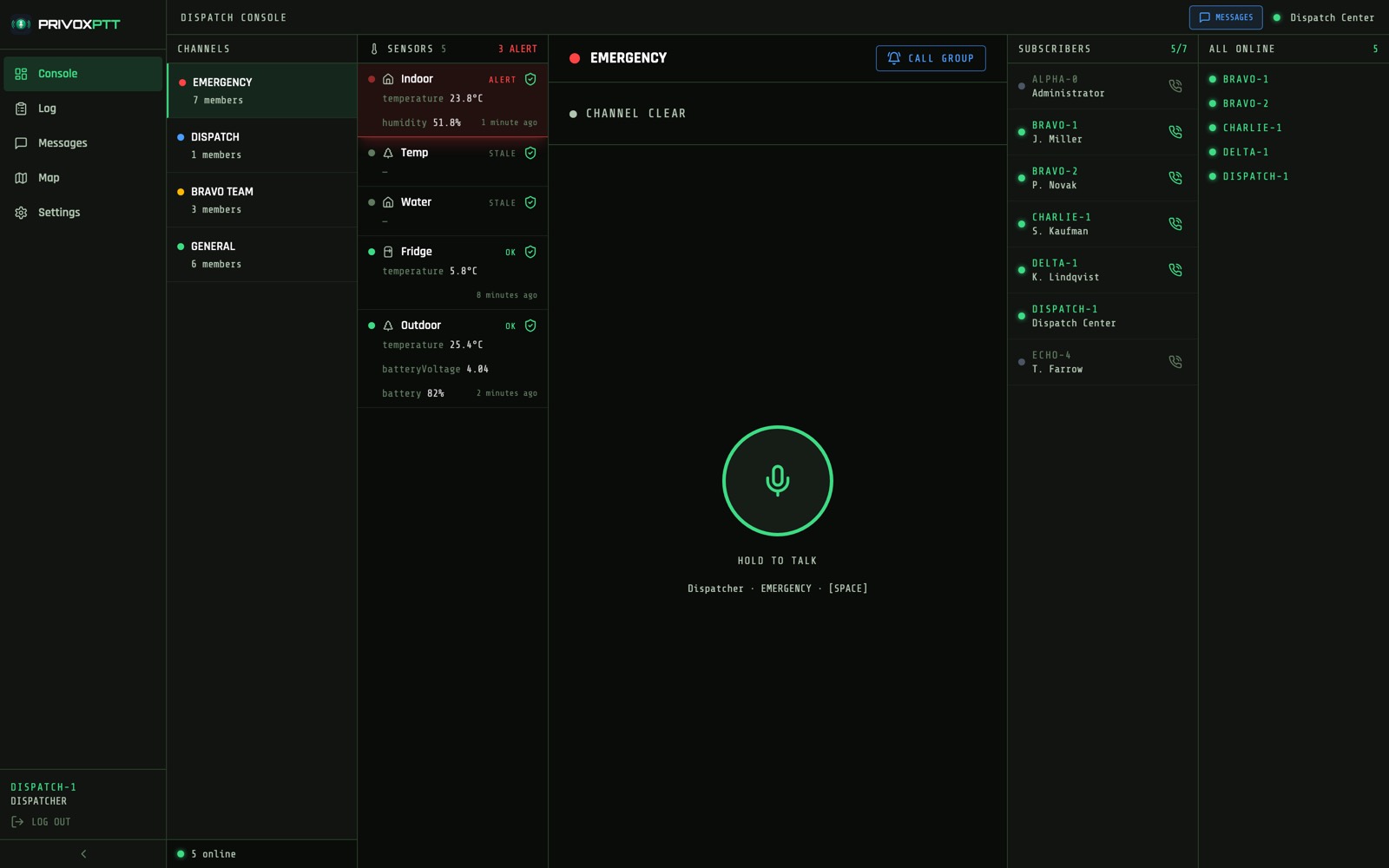
The dispatcher console. Channels on the left, then the site's sensors — one in alarm, two silent. On the right the shift: who is on air, with a call button for each person.
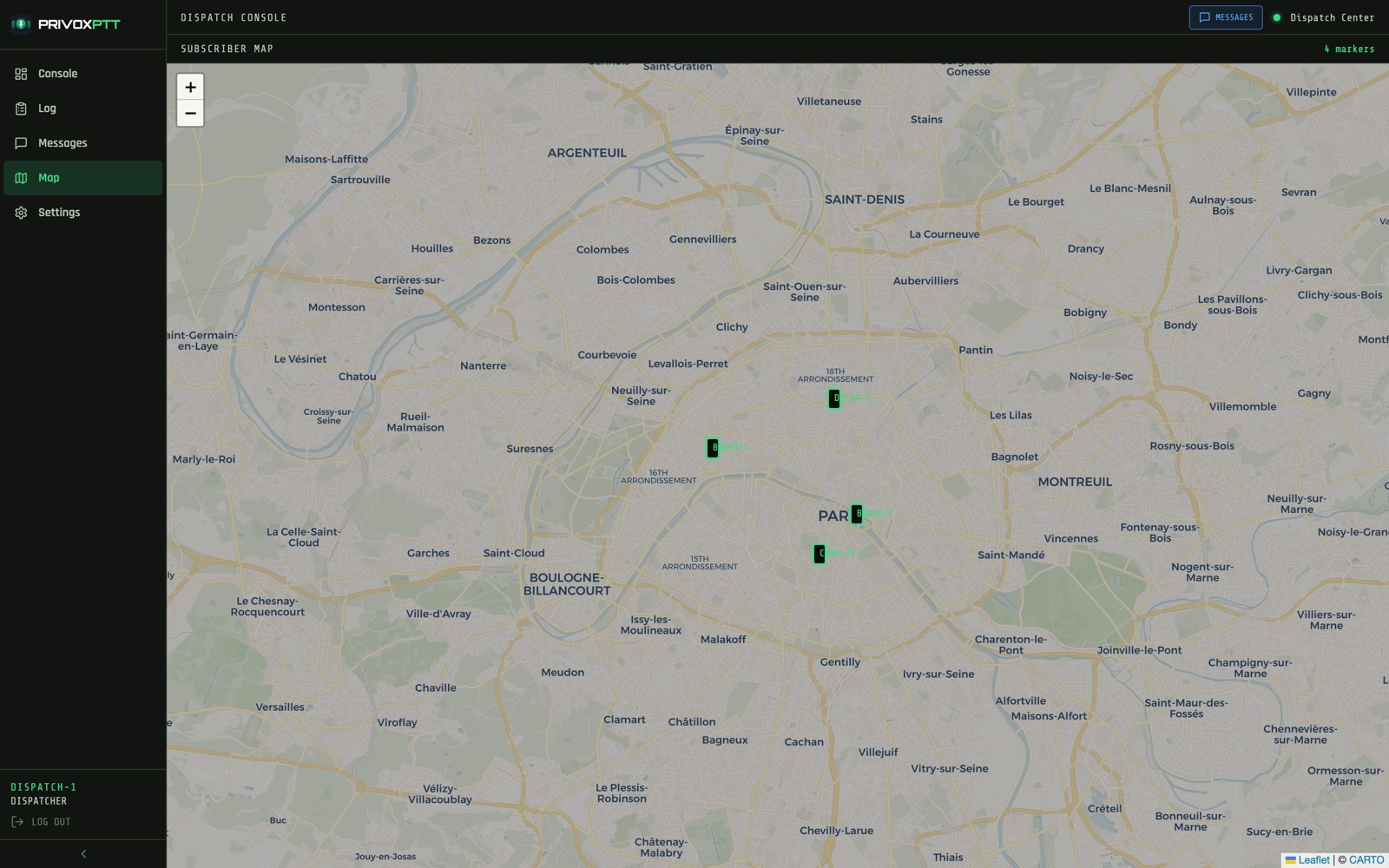
The shift on the map. Markers move with the people; the tooltip carries the callsign and speed. You can see who is closest to an incident.
DEVICES
Phones and radios on the same channel
A guard with a radio, a technician with a phone and a dispatcher at a desk sit in the same group and hear each other. No gateways, no adapters.
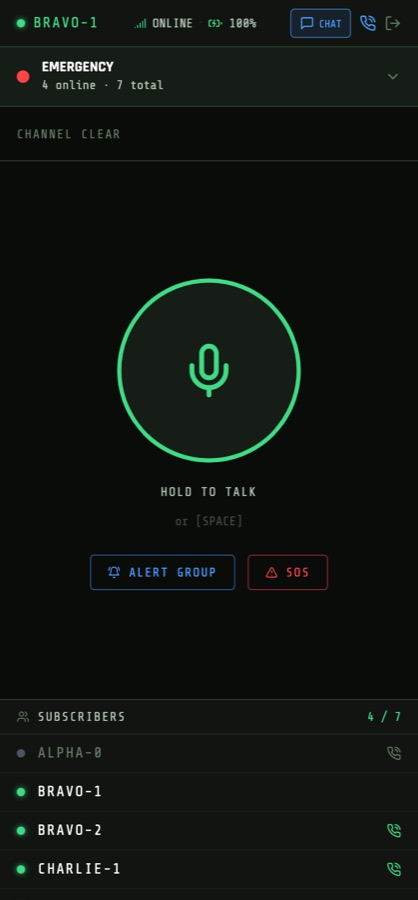
PHONE
An app for Android and iPhone. An incoming call wakes a phone in a pocket — even with the app closed.
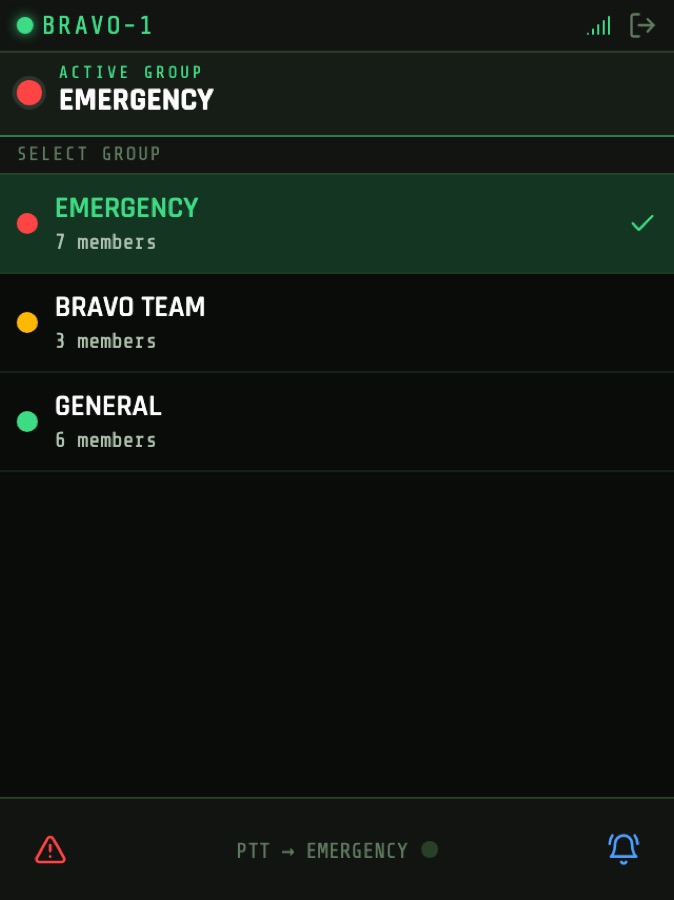
RADIO
A hardware talk key, one-handed operation, works with gloves on. For the posts where a phone is awkward.
Which devices suit you is a conversation, not a package. In some places the phones people already carry are enough; at fixed posts a proper radio earns its keep. We match this to the property rather than selling one standard kit.
WHAT ELSE IS INCLUDED
More than voice
| Capability | What it is for on a property |
|---|---|
| Private call | A one-to-one conversation like a phone call, without occupying the shared channel. |
| Calling the shift | One button and every member's phone rings for real, even at night. |
| Emergency button | The signal crosses group boundaries and reaches the whole organisation. |
| Messages and photos | An address, a plate number, a picture of a fault — things you cannot pass by voice. |
| Member permissions | Who may speak, who only listens, who shares a position. |
| Access with an expiry | Seasonal staff and contractors get access until a date, and it lapses on its own. |
| Joining by QR | A person scans a card with the camera and is on air — no logins, no setup. |
HOW TO START
A trial on one real property
Talking about communication is pointless until it has been used in the field. So we suggest starting with a trial deployment on one of your sites — with real people and a real shift.
Scope, duration and composition are matched to the property: how many people, which services, whether radios are needed. Afterwards we look at what only practice reveals — how the link holds inside real walls, how it moves between Wi-Fi and cellular, and whether people use it without being trained.
A conversation
We look at your properties and services: where communication breaks down today and what costs you most.
A live demonstration
We show the system working: voice, console, map, sensors. On your property if you prefer.
Trial deployment
One site, a real shift. Terms are agreed together — they depend on the scope.
GET IN TOUCH
Ready to show the system at work
Write to us and we will arrange a demonstration — on your property or remotely. We will be straight about what the system does today and what is still ahead.
Download PDF